The are many reasons why septic tank systems fail and this can be down to poor maintenance, misuse of the system or the tank and its soak-away can just naturally come to the end of their working life,
In the best tradition of list making here are the top ten reasons why systems tend to fail.
1 - Lack of maintenance on septic tank system
Of course septic tanks are out of sight and out of mind until they fail that is, but it is essential for the longevity of the system that the tank is maintained and emptied on a regular basis. Owners of properties on main line drainage have to pay rates towards the handling and disposing of waste and tank owners should not assume that having a septic tank system means they are exempt from some annual costs
The life span of any septic tank system is dependant on many things such as location, ground type, discharge point, the size of the system and the number of occupants in the property, the following items also highlight defects that can affect the workings of a tank.
I can not therefore sit here and tell you how often your tank should be emptied but most literature provided by manufacturers recommend that the tank be emptied yearly. Having the tank emptied on a regular basis is good practice and the guy that empties the tank can pick up the early warning sign`s of a problem such as water running back into the system from the outlet, missing dip pipes and the level of the tank being low due to a leak.
Septic tanks that are not maintained start to grind to a halt as the crust and sediment in the holding chambers build up to a point that the bacteria can not cope, as a result the Dip Pipes and H pipes can become clogged as can the inlet pipe to the tank itself.
The clarity of the water passing through the tank deteriorates greatly and more sediment is washed through to the filter system or soak-away and again shortens the working life on this section of the system. Should your outlet discharge directly into a river, brook or culvert then obviously there is a greater risk of pollution and a hefty fine from the rivers authority.
2 - Damage to dip pipes in a septic tank
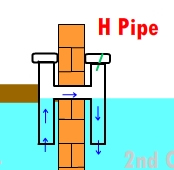 We find many poorly constructed brick built septic tanks that have no means of separating the solids and matter from the liquid waste, more often than not though we find that the Dip Pipes and H Pipes have become detached and are lay in the base of the tank. We find many poorly constructed brick built septic tanks that have no means of separating the solids and matter from the liquid waste, more often than not though we find that the Dip Pipes and H Pipes have become detached and are lay in the base of the tank.
This is usually due to the heavy and brittle vitrified clay pipe work being knocked or disturbed during the emptying process, the clay pipe work used is fragile and easily broken through an impact.
The inlet Dip Pipe is also prone to being damaged due to over zealous rodding or jetting works, especially if the tank is buried or concealed and the chap at the other end of the rods thinks he is up against a root mass or similar and is going for glory.
3 - Damaged baffle walls in septic tank
Baffle walls within brick built chambers are usually there to serve a purpose only and are not part of the structure of the tank, for this reason they are usually of single brick construction, this and the fact that they are submersed beneath water on both sides means they usually have weak and deteriorating mortar holding them together and again they can be damaged through the emptying process.
4 - Leaking or damaged structure
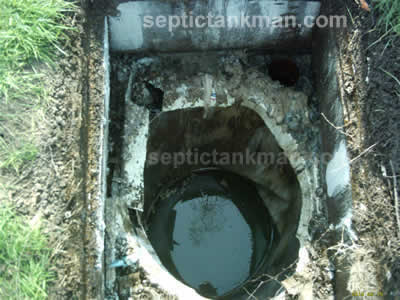 Brick built and concrete sectional structures beneath the ground are subject to the same stresses and strains as any drainage system, as a result septic tanks can fail from root ingress, ground heave and damage from vehicular movement. Brick built and concrete sectional structures beneath the ground are subject to the same stresses and strains as any drainage system, as a result septic tanks can fail from root ingress, ground heave and damage from vehicular movement.
A leaking system can affect or pollute local water courses, brooks and rivers as well as the ground water in close proximity, a lack of water passing through the system obviously affects the internal workings of the tank.
Many septic tank systems are partially above if not fully above ground level in areas with shallow bed rock or where tanks are built into steep inclines and banks, this means that the structure is open to harsh weather conditions including frost which can affect external brickwork. We therefore find that remedial brickwork repairs and rendering of internal walls is required to return the tanks to a water-tight condition.
5 - Blocked inlet/outlet pipes on septic tank
The inlet to a septic tank can become blocked as any drain can due to root ingress or damage from vehicular movement, they are also prone to a build up of grease and fat if the level in the tank is high, if there is no dip pipe on the inlet to the tank the crust that forms in the first chamber can cover the inlet and block the system.
The outlet pipe from a tank can again be prone to root ingress particularly if the pipe is perforated or a butted land drain type, tanks that are not maintained allow large deposits of sediment to pass through them which accumulates in the out fall until the system blocks.
6 - Storm water entering septic tank
Storm water from roofs and hard standings should not pass through a septic tank system, by overloading the system you will affect the workings of the bacteria and enzyme in the tanks and the increase in volume passing through the system will carry debris and sediment through the process and into the out falling pipe work, soak-away or filter tank.
Dependant on the ground type storm water should run to soak-aways or directly to rivers, brooks or culverts, it is not uncommon to find the storm water system connecting into the outlet pipe work from a septic tank so as to dilute the final product before it reaches its out fall
7 - Chemicals or detergents affecting bacteria in a septic tank
The Plethora of products we pour down our toilets and sinks will affect the way that the bacteria and enzymes operate within the septic tank, there are tank friendly products on the market and products that kick start or top up the bacterial process, failing that you can as many of the old farmers used to do, throw in a dead cat or road kill to get things moving.
8 - Wrong size septic tank installed
The small brick built septic tank system at the rear of the country cottage has coped for 50 years without a problem for the old couple who use it, then the family of four move in with the washing machine, dishwasher, showers and detergents and it just can not cope with the volume passing through it.
9 - Blocked filter media in filter tank
Poor maintenance and general misuse of a system usually means that grease, fat, fibre and sediment passes through the system and clogs any filter system installed, this of course prevents water from reaching the outlet and the system surcharges and floods.
10 - Saturated soak-away on outlet of septic tank
As with the filter systems poorly maintained tanks usually affect the soak-away with grease, fat, fibres and sediment clogging the sub-soil and preventing water from dispersing into the ground. We are often called out to look at a defective septic tank only to find that it is the soak-away that has failed
|
